Augering, Boring & Pipe Ramming
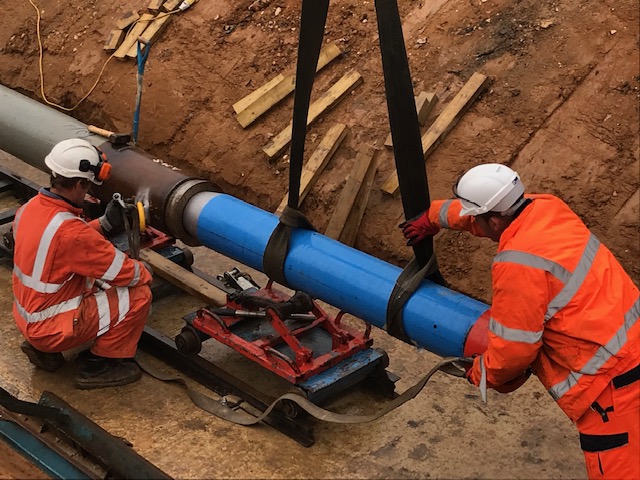
Hall cribbs drilling operate a wide range of Auger Boring systems, and pipe ramming. pipe sizes range from 90mmØ up to 1016mmØ can be installed, with jacking forces from 10t to 150t working from 2.0m long pits or 2.1mØ standard round shafts, ideal for auger boring in a wide range of ground conditions and where minimal settlement is critical, up to distances of 100m. Cribbs drilling is a precision-driven process distinct from traditional Auger Boring, designed for accurate installation along predetermined lines and levels, ideal for gravity-dependent systems like sewers. The operation starts with the establishment of launch and reception shafts that accommodate the boring machine. Equipped with a jacking frame and usually a thrust backing, the machine is positioned in the launch shaft and aligned with the intended route.
A laser-based optical guidance system is set to ensure the bore follows the correct line and level. The boring process involves an initial pilot bore, guided by directional drilling techniques similar to those used in Horizontal Directional Drilling (HDD). The pilot bore guides the subsequent installation phases, with a cutting head auger following to excavate the bore to its final diameter. Spoil from the drilling is conveyed back to the launch shaft for removal. Once the bore reaches the required diameter, the casing or product pipe is pushed into place, and the installation machinery and casing are then retrieved from the reception shaft.
The Method
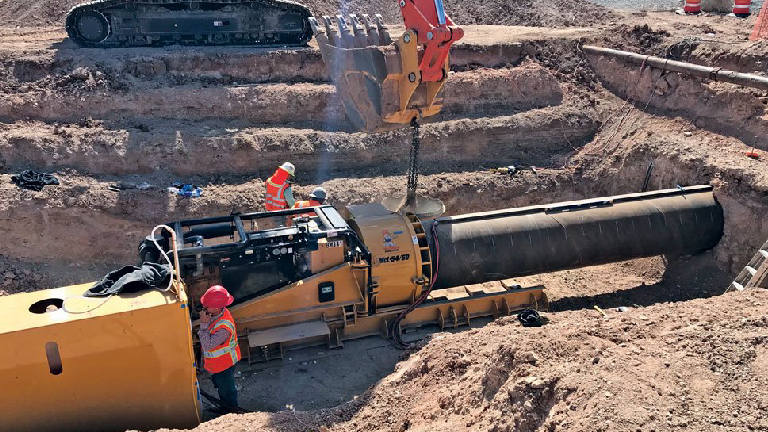
Auger boring is a non-steered method used to install pipes from 150mmØ to 1,000mmØ. During installation the pipe fully supports the ground while the cut spoil is conveyed by continuous flight auger back to the work pit.
- Using these compact auger boring machines there is no slurry created.
- The process is quick and efficient meaning overall costs are kept to a minimum.
- Only a small footprint for the working area is required.
- The ground is fully supported during installation.
- Is unaffected by surface obstacles
The ideal solution to traditional methods, used to install steel sleeve pipes and casing ducts through embankments or loose ground, Pipe Ramming is extremely versatile. It can operate from a pit or above ground level as does not require a thrust wall. Pipe Ramming is also a fast solution and in many cases, has lower overall costs. As No-Dig installation specialists, we own and operate a wide range of Pipe Rammers, and have installed pipes up to 130m in length.
Application
This method is suitable for installing gas, water, cable, and sewer systems ranging in diameter from 90 mm (3½ inches) to over 1,000 mm (40 inches) and up to 100 meters in length, depending on the soil type. It is primarily used in softer soils, though with the appropriate boring heads, it can also tackle harder soils and soft rock. It should be noted that the accuracy of this steered boring system is approximately ±25 mm over a 50-meter length, so installations requiring greater precision might need a more accurate technique such as Microtunnelling.
Benefits
- Pipe diameters can range from 150mm to 1000mm and lengths of 100 metres
- Accurate to +/- 40mm over a 50 metre shot
- Approved for pipe installation under live rail
- System can install final product pipe or steel sleeves for later slip lining and grouting
- Hall cribs drilling auger boring installation rates of up to 50 metres per day
Typical Applications:
- Steel pipes from 150mmØ – 1,600mmØ for drainage culverts or to accommodate multiple services
- Under railways, roads, rivers, airports, buildings, contaminated landfill sites and SSSI
- Crossings can be for Water, Oil, Gas, Electricity, Sewerage, Chemicals, Communication Ducts and Outfall. Auger Boring provides a safe, slurry-free method of installing pipes and cable ducts. This No-Dig technique can operate from a shaft as small as 2.40mØ and causes no disruption to the surface.
- We own and operate the widest and most versatile range of Auger Boring systems including large diameter boring machines where needed, with jacking forces up to 260te, allowing us to install steel casings and ducts where conventional open-cut methods of engineering are impractical.
- Pipes and ducts from 100mmØ – 914mmØ over distances of 5m – 100m
- Under railways, roads, rivers, airports, buildings, contaminated landfill sites and SSSI
- Crossings can be for Water, Oil, Gas, Electricity, Sewerage, Chemicals, Communication Ducts and Outfalls
Pipe Ramming Solutions
At Hall Cribbs Drilling, we are a leading force in the United States technology industry. Specializing in pipe ramming, we expertly install steel pipelines up to 1000mm in diameter and 100 meters long in a single operation. This approach serves as a sustainable alternative to traditional. Greatly reducing environmental harm and waste. Our method not only avoids the substantial disruptions of conventional but also significantly lowers installation costs and improves the visual appeal of project areas, ensuring your ventures are economically sustainable.
Benefits of Pipe Ramming
Pipe ramming is a fast and effective method for installing large-diameter pipelines over distances up to 100 meters. It directly targets the installation path, minimizing surface disturbance and retaining most spoil within the pipe, which is later cleared. This results in minimal ground settlement, making it one of the most non-intrusive methods available.
Previous
Next